Buy 3 Garments get a personalized Gift


🌿 The True Silk GuideHow to Shop: Understand & Recognize Real SilkWhen it comes to identify real silk vs syntetics or blends, there is so much confusion in fashion today, and consumers are overwhelmed, and I’m not surprised. Brands often use soft, romantic language to disguise synthetics, naming polyester and rayon things like “vegan silk,” “bamboo silk,” “plant-based silk,” “eco-silk,” or simply “satin”. These phrases sound ethical or luxurious, but they are almost always chemical fibers, not real silk. True silk never hides, it will clearly say 100% silk or 100% mulberry silk. If the label isn’t explicit, it isn’t silk. When they shop most people don’t know how to recognize what is real silk, why pricing varies so dramatically, or why some premium brands even line a silk dress with viscose instead of silk. So let’s make this simple, honest, and empowering, so you can understand what you’re truly wearing, recognise true quality, and how to shop for real silk with confidence. |

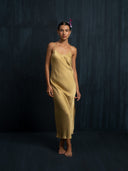
In Desa Tenganan, life follows awig-awig — customary law that governs daily ritual and sacred architecture, preserving one of Bali’s oldest natural dye traditions. Our marigold silk dresses, the Aphrodite Silk Dress and Mila Halter Dress, were photographed inside the village bale in alignment with this ancestral order. Marigold was the first plant I ever dyed with and remains central to our practice, symbolising protection, transition, and the cycles of life. |
🌱 What Is Mulberry Silk?When shopping for real silk, you’ll often see brands label their products mulberry silk — but what does that actually mean? Mulberry silk comes from the Bombyx mori silkworm, the world’s only fully domesticated silkworm species. It feeds exclusively on mulberry leaves and produces the soft, fine, glossy silk most people are familiar with. But here’s what most don’t know when they try to recognize real silk: 💡 Mulberry is just one type of real silk. Any fibre made by a silkworm is real silk — and there are over a thousand wild silkmoth species worldwide. Only a few, like tussar, eri, and muga, are widely known. The rest exist in small, regional traditions — from yellow-cocoon silks in Vietnam and Thailand, to forest silks in Laos, China, and Japan, to locally bred Bombyx mori and wild Antheraea species in Sulawesi, Indonesia. So when labels identify mulberry silk, it doesn’t mean “the only real silk” — it simply identifies the species: Bombyx mori. Real silk exists in many forms, shaped by landscape, climate, and culture. Understand Real Silk Itself Silk is an animal-derived protein fibre, which means:
Mulberry silk stands apart because it has:
These are measurable qualities — not marketing language. Recognizing this, real mulberry silk is the finest choice for luxury garments, especially bias-cut pieces that rely on drape and natural stretch. At RIMMBA, we use Grade-A, 19-momme mulberry silk charmeuse for its perfect balance of strength, fluidity, and longevity. |

Our marigold silk dresses — the Aphrodite Dress and Mila Halter — photographed draped like goddesses in Desa Tenganan, Bali. Marigold holds deep cultural symbolism across South Asia and Indonesia, often associated with Goddess Durga, the force of creation and dissolution. Marigold was also the first plant I used in natural dyeing five years ago. Its chemistry, smell, and vibrant colour have stayed with us ever since, forming one of RIMMBA’s most meaningful and exciting dyes. |

ombré silk slip- The centerpiece of our collection, this slip showcases a highly technical natural-dye process: a controlled green–blue gradient created by layering mango leaf with indigo through layering and dipping. The result is a stable, seamless transition that cannot be achieved with synthetic dyes or printing. Cut on the bias for a precise, fluid drape, each garment is constructed twice — before and after dyeing — to accommodate the silk’s natural shrinkage and structural change under heat. This piece reflects the discipline of RIMMBA’s craft. |
🐛 Different Silks From Different SilkwormsNot all silk is the same.Recognize different kinds of real silk: when worms eat different plants, creates different types of silk: |
| Silkworm | Diet | Silk Name | Look & Feel |
|---|---|---|---|
| Bombyx mori | Mulberry leaves | Mulberry silk | Smooth, fluid, glossy, finest |
| Samia ricini | Castor leaves | Eri silk | Matte, soft, “wool-like,” ethical |
| Antheraea assamensis | Som / Soalu leaves | Muga silk | Golden, rare, extremely strong |
| Antheraea mylitta | Forest leaves | Tussar silk | Textured, raw, earthy |
| Antheraea pernyi / yamamai | Oak leaves | Oak tussar | Crisp, structured |
|
Understand these are all real silk, but they behave differently. No silk is “better” in a spiritual sense.Mulberry silk is simply the most refined for high-drape luxury garments. |

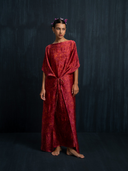
Bella’s red silk kaftan, worn by both models. Each piece is made using eco-print, where whole plant materials are pressed and steamed onto the silk to release their natural pigments. Because every leaf and flower transfers colour differently, each kaftan develops its own variation in tone and motif. This is the inherent beauty of botanical dyeing: no two pieces are ever the same. |
✨ Silk vs Viscose vs Satin vs PolyesterThis is where confusion happens: silk vs syntethics. |
| Fabric | What It Is | Notes |
|---|---|---|
| Mulberry silk | Natural protein fiber | Breathable, luminous, alive |
| Viscose/Rayon | Plant pulp chemically processed | Soft, heavier, imitates silk |
| Polyester | Petroleum plastic | Shiny, doesn’t breathe |
| Satin | A weave, not a fiber | Can be silk satin or polyester satin |

Karunia Fischer, founder and creative behind RIMMBA, dyeing with seasonal plants from her garden. Here, she is mordanting the silk to prepare it for the dye process. |
Silk vs SatinWhat’s the Real Difference?The main difference is this: Silk is a natural fibre. Satin is a type of weave.
“Silk” describes what the fabric is made from — the raw material itself. “Satin” describes how the fabric is woven — the structure that creates a glossy surface on one side and a matte finish on the other. Because satin is just a weave, it can be made from any fibre:
This is why a label that says simply “satin” tells you nothing about the quality of the fabric, just the weave. To be able to recognize if that is real silk, the fibre must be listed. The rule:If a label says “satin” but not “100% silk satin” then it is not real silk, it is usually polyester satin (plastic). How each feels
Today, imitation silks are made so convincingly that most shoppers cannot recognize real silk from polyester satin. In truth, many people have never touched pure mulberry silk at all. Silk represents only 0.2% of the global textile market. Real silk is rare, and that rarity is part of why it requires education, transparency, and touch to truly understand and appreciate. |


Silk Chiffon Deep Indigo Scarf - The crinkled chiffon measures 2.05 meters (80”) in length and 70cm (27.5”) in width — intentionally designed to be long and slim allowing you to wrap, drape, or veil yourself in silk. |

Deep Blue is inspired by the fluid nature of water — a reminder to be like water: ever-shifting, flowing freely through time and space. To remain supple in the face of life’s transitions, and to keep moving — for life itself is flow. Indigo Silk Scarf |
👜 Why Do Some Luxury Brands Line Silk Dresses With Viscose?Great question! It confuses shoppers all the time. Silk lining is expensive.Viscose lining is cheaper.So some luxury brands use silk only on the outside, where you see and touch it in the store, and line the inside with viscose. It looks luxurious on the hanger, but your skin touches synthetic fiber. This is a margin decision, not a craft decision. At RIMMBA, when we say silk, we mean 100% pure real silk.We never dilute our garments with viscose, polyester, or synthetic blends. If a piece requires lining, we use silk lining or light cotton, depending on the client’s preference and the feel of the garment. Nothing synthetic, ever. That is what real luxury means to us: felt on your skin, not just seen on the tag. We recognize the value of real silk. |

Pak Abdul, our tailor who works from our home atelier, crafting beautifully made silk dresses for our customers. |
8 Essential Questions to Ask a Brand to Recognize Real Silk:
|

Pak Abdul taking measurements for custom silk dress orders. |
🌿 The RIMMBA Silk StandardAt RIMMBA, we create silk garments the slow, intentional way:
We recognize the value of real silk: nature first, culture honored, transparency always. Real silk is sacred work, earth, water, hands, and patience. |

The Tussar silkworm (Antheraea mylitta) can be identified by its green body, the distinctive purple tubercles along its sides, and its bright yellow-orange spiracles. Compared to other wild silkworm species, it has a slightly bristlier appearance and feeds on a variety of forest trees. This species produces Tussar silk — a naturally golden, softly textured fibre prized in many regional weaving traditions. Photo credit: gailhampshire — from Cradley, Malvern, U.K. |
🕊️ What Is Ahimsa Silk?Cruelty-free SilkYou may come across the term Ahimsa silk or Peace silk, often described as “cruelty-free silk.” The word Ahimsa comes from ancient Indian philosophy, meaning non-violence, non-harm, and reverence for life in all forms. While silk has been made for thousands of years, the Ahimsa method was brought forward more recently in India, inspired by Gandhian values. The intention was simple and beautiful: to create silk in a way that allows the moth to live out its natural cycle, instead of harvesting the cocoon before it emerges. It is a philosophy first, a textile second, rooted in compassion. |
🌿 How it is MadeIn traditional silk, the cocoon is collected before the moth breaks through, preserving one continuous filament that can be reeled into a long, fluid thread. Ahimsa silk takes a different path.The moth is allowed to emerge, breathe, mate, lay eggs, and complete its short life. When it breaks free, the filament inside the cocoon also breaks. So instead of being reeled, the silk must be spun, more like cotton or wool. Ahimsa process:
True Ahimsa silk is therefore rare, slower to produce, and naturally more costly, and its price should reflect that respect. This is why genuine Ahimsa silk garments, especially bias-cut dresses, are extremely rare, and rightfully expensive |

In Mankro, Assam, an artisan holds Samia ricini — the eri silkworm long cultivated throughout Northeast India. Unlike the smooth-bodied mulberry silkworm, eri larvae are thicker and paler, with a sturdier form and small, soft tubercles characteristic of the species. Eri rearing is a generational practice within many of Assam’s tribal communities, where women are closely involved in caring for the worms and preparing the cocoons. The fibre produced — known as Eri or “peace silk” — is valued for its durability, warmth, and the deep cultural significance it carries in the region’s textile traditions. |
📍 A Silk Rooted in Place & TraditionOrigins of Ahimsa SilkMost genuine Ahimsa silk comes from northeast India, especially Assam, where communities have practiced sericulture for generations. Here, the Eri silkworm feeds on castor leaves, and women hand-spin and weave the yarn on simple spindles and looms. These textiles carry culture, care, and continuity, not just fiber. Ahimsa silk reminds us that luxury can be gentle, honoring both nature and life. |
🌬️ A Gentle PerspectiveSilkworms have lived alongside humans for thousands of years, much like sheep in wool traditions. Even in nature, a silkworm’s moth life is only about two weeks. Ahimsa silk is not a “better vs worse” story, it is simply a different philosophy and intention. For many, choosing Ahimsa silk is a spiritual or ethical choice. What matters most is honesty: true peace silk is rare, labour-intensive, and never cheap. When a garment claims to be Ahimsa silk, transparency should be clear, who grew it, where it was woven, which species was used, and whether the moth was truly allowed to emerge. Real peace silk carries real truth, because it is made with conscience, not marketing language. |

This fabric is an 80% Muga and 20% Tussar silk blend, displaying the natural golden sheen for which Muga is renowned. The high proportion of Muga lends the material its characteristic warmth, fine surface quality, and impressive strength, while the Tussar component introduces a softer matte note and slight, organic irregularity. Light, crisp, and subtly lustrous, the blend reflects the distinct qualities of both wild silks — pairing Muga’s celebrated radiance with the grounded, earthy character of Tussar. |

Shown here are two of Assam’s distinct cocoons: the soft, open-ended Eri cocoons (Samia ricini) on the left, and the tighter, naturally golden Muga cocoons (Antheraea assamensis) on the right. Eri moths emerge on their own, leaving a fluffy fibre used for spinning, while Muga cocoons are reeled intact to preserve their long, continuous filaments. Together they reflect the core of Northeast India’s sericulture — two species, two processes, and two very different silks with their own cultural importance. |

Artisans preparing raw silk fibres by hand, separating each filament across a wooden frame to ensure even tension before the threads are wound and prepared for weaving. This step is essential in wild-silk processing, where no two fibres are identical. |

At a handloom in Guwahati, Assam, a young weaver works with silk and cotton threads held under precise tension. Beside her hangs a strip of punched pattern cards — an early analog coding system that controls which warp threads lift to form the design. This method remains central to Northeast India’s weaving heritage, where the coordination of loom, pattern cards, and the weaver’s skill produces Assam’s distinctive textiles. |
🧵 Key Questions to Ask About Ahimsa SilkIf a brand claims Ahimsa silk, simply ask:
True peace silk will always be transparent, because it is created with conscience. It is a significant investment for any brand to work with real Ahimsa silk, and founders who commit to it know every detail: the species of silkworm, the farmers, the region, the philosophy, the spinning method, the price reality. They have done the digging, the questioning, the sourcing. Because true Ahimsa silk is rare and hard to come by, the brands who use it can answer these questions easily and proudly. If those answers don’t exist, it’s not Ahimsa silk. And if the brand is pricing it cheaply, it’s certainly not real Ahimsa silk. |
🌸 Our Silk Philosophy at RIMMBAAt RIMMBA, we work with a variety of real silks, all natural and genuine, each chosen with intention, respect, and purpose. The majority of our garments are made from Grade-A mulberry silk from the Bombyx mori silkworm (often called Bombyx mori), traditionally raised on mulberry leaves. This silk is known for its long, luminous filament, strength, and fluid drape, perfect for bias-cut silhouettes and our botanical dye work. Our mulberry silk is responsibly produced and sourced from China, where the craft has been refined for thousands of years. We also create select pieces using wild and peace-philosophy silks that fall under the broader category of Ahimsa-aligned silks:
These silks were gathered on our journey through India and carried home to Bali, precious, limited, and held for special requests, one-of-a-kind creations, and ceremonial pieces. |
🌿 What matters to usWe choose our silks based on:
Luxury to us is not about claiming purity: it’s about being transparent, intentional, slow, and real. |

In Balinese tradition, a doorway is more than architecture; it is a protective threshold between two realms: sekala, the seen physical world, and niskala, the unseen spiritual dimension. This dual understanding is central to Balinese Hindu philosophy, where life is understood through both visible and invisible forces, and harmony depends on respecting each.Models wearing our Lily Cosmic Silk Dress and Scarlett Dress in indigo Circle. |

Nindy wears our Red Eco-Print Wabi-Sabi Kimono — a botanical imprint on pure mulberry silk. The fabric is tightly bundled into a spiral and layered with seasonal plants such as brazilwood, marigold petals, onion skins, and hibiscus. It is then gently steamed, allowing each plant to release its pigment and transfer its form onto the silk. |
Our Silk
|

Shot in Desa Tenganan, one of Bali’s oldest Bali Aga villages. Our Aphrodite and Parvati silk dresses are framed by dancing flowers in tribute to the botanicals behind our dyes. The models stand before Tenganan’s iconic mud wall — one of the few structures that remained standing during the earthquake. |
🤍 We will leave you with this:Silk is not cheapNor was it ever meant to be.It is one of the most time-intensive, labor-intensive, and resource-intensive fibers on earth.
There are hands, seasons, water, and patience woven into every thread. To create just one silk dress, thousands of silkworms have lived, thousands of mulberry leaves have been grown and harvested, and skilled artisans have tended each step. This is not a fast fabric. It is a sacred craft. So when the market races to the bottom, when brands sell “silk” suspiciously cheap, or disguise synthetics with soft language, something is being compromised. Production ethics. Fiber quality. Worker dignity. Truth. Silk is precious. Silk is earned. Silk is not a bargain. If a price feels too good to be true, it is, and something in the story doesn’t add up. Choose carefully. Honor the craft. Pay for real work, real fiber, real people, real land. Recognize that real silk deserves respect, and so do the beings and hands who make it possible. |
A guide on how to shop for real silk:
- How to Recognize Real Silk
- What is Mulberry Silk
- Silks From Different Silkworms
- Silk vs Viscose vs Satin vs Polyester
- Difference between Silk and Satin
- Why do others line Silk with Viscose?
- What to ask before purchasing silk
- RIMMBA Silks Standards
- What is Ahimsa Silk
- How is Ahimsa silk made
- History of Ahimsa silk
- Why choose Ahimsa Silk
- Choosing your Ahimsa Silk
- Silk Philosophy at RIMMBA
- Considerations about Silks