Buy 3 items get 15% OFF


Eco Textiles and Natural Fabrics guide:
Why We Choose Only Natural FabricsAt RIMMBA, we stand firm in our commitment to use 100% natural fabrics — silk, cotton, linen, and ramie — in every garment we create. In today’s world, more than 70% of textiles are made from synthetics, a number that continues to grow as fast fashion dominates the industry. These petroleum-based fabrics may be cheap to produce, but they come at a hidden cost: to our planet, and to our health. We believe that what touches your skin matters. Our skin is the largest organ of the body, and it absorbs the energy and chemistry of the materials we wear every day. Natural fabrics breathe, protect, and age beautifully, while synthetics can trap toxins and contribute to the global waste crisis. For you, for EarthThough natural fibers are more expensive to source and work with, we choose them because our health, our Earth, and our heritage matter more than cutting costs. Every RIMMBA piece is created with intention — softer on your skin, kinder to the planet, and aligned with the timeless craft of natural dyeing in Indonesia. In every weave and fibre, we honour the Earth’s original materials — not their imitations. |
 Cotton fabric hanging to dry after a deep wash and natural scouring — preparing the fibres to fully open and receive colour. Soon these pieces will be dyed with ketapang leaves (the Umbrella Tree), a beloved Indonesian tannin-rich plant that yields earthy yellow tones. Another slow, plant-led step in creating our collection. |

These trays guide each Bombyx mori silkworm to spin its cocoon in an orderly, protected space. As the worms begin their final stage of life, they create a continuous filament of silk — one of the strongest and most lustrous natural fibres in the world. Explore our silk collection here. |

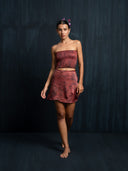
Mud dyeing on silk — a process that begins with coating the fabric in rich tannin plants, then layering it with iron-rich mud. Practiced in Indonesia, as well as in parts of Africa, China, Japan, and India, this ancient craft transforms silk into deep, earthy tones through the pure alchemy of soil and plant.Shown here on our Aphrodite Silk Dress. |
What Are Natural Fabrics?Natural fabrics are textiles made from fibers that come directly from plants or animals — grown, harvested, and processed without synthetic origin. They include bast fibers like ramie and linen, seed fibers like cotton, and protein fibers like silk. Unlike synthetics derived from petroleum or chemical extrusion, natural fibers are alive — they respond to humidity, temperature, and wear. They breathe, biodegrade, and form patina over time. Their tactile irregularities are not flaws but signatures of authenticity. Each natural fabric at RIMMBA carries its own essence:
These fibers define our collections not only by their beauty but by their integrity — each one a dialogue between Earth, craft, and time. |

Our signature ombré silk slip — a seamless fade from green to deep blue, created through the meeting of mango leaf and indigo. A luminous dress where two plant worlds merge on pure silk, revealing a gradient only nature can paint. |

100% organic cotton pants, dyed from indigo leaves. Light, breathable, and incredibly comfortable — an everyday pair that can be dressed up or down. Gentle on the skin and naturally cooling. |
Why Choose Natural Fabrics?Because they breathe. Because they last. Because they return to the Earth. Natural fabrics are inherently biodegradable, meaning they can decompose naturally without releasing microplastics or toxins. They are also renewable: flax, cotton, and ramie can be regrown seasonally, while silk depends on mulberry trees that sustain ecosystems. When worn, natural fibres adapt to the body’s climate. They cool in heat, insulate in chill, and soften with wear. They also carry a kind of emotional longevity: as the fibres age, they develop texture, fading, and individuality that fast fashion cannot imitate. In RIMMBA’s philosophy, natural fabrics are not only sustainable but sentient — they interact with your life, responding to touch, movement, and care. Each garment becomes a living object, maturing alongside its wearer. |
The Properties of Natural FabricsBeyond aesthetic appeal, natural fibres hold remarkable technical properties that make them both luxurious and functional:
|

100% Tussar silk, also called “wild silk,” is produced by silkworms that feed on forest leaves rather than mulberry. This gives the fiber its iconic golden hue and textured feel. Tussar is prized across India for its durability, breathability, and organic, untouched character. |

Cotton yarn from Threads of Life, colored with morinda root, one of Indonesia’s oldest traditional dyes. The red tones are created through careful layering and long, patient dye cycles preserved by generations of artisans. |
How Are Natural Fabrics Made?Each fibre undergoes a transformation — from raw material to wearable art. At RIMMBA, we work only with natural processes and ethical partners to preserve integrity from start to finish.
|

Khadi cotton from my trip to India — a fabric hand-spun and hand-woven on traditional wheels and looms. Once revived during India’s independence movement, khadi symbolizes simplicity, self-reliance, and dignity for the artisan. Its soft, breathable texture carries the subtle irregularities of true handmade craft. |

The flax plant — the source of linen — grows in cool, temperate regions with rich, well-drained soil and steady moisture. It appears as tall, slender green stalks topped with delicate blue or white flowers. Inside these stems lies the strong, ancient fiber that becomes linen. |
A Brief History of Natural FabricsNatural textiles have clothed humanity for over 10,000 years. Before synthetic chemistry, fibers were drawn from what the Earth offered — silk from cocoons, cotton from bolls, linen from flax, ramie from nettle stems. Each region wove its identity through these materials. Silk in ancient China became a currency of art and empire. Along the Nile, linen wrapped pharaohs in ritual purity. In India, cotton and ramie were spun into Khadi, a symbol of self-reliance and freedom. These fibres built economies, cultures, and spiritual connections long before polyester existed. Today, natural fabrics are being rediscovered not as nostalgia, but as necessity — sustainable, regenerative, and profoundly human. RIMMBA continues this legacy, merging traditional wisdom with modern design. |

Over 6,000 years old, linen is one of humanity’s oldest textiles. In ancient Egypt, it was considered a sacred fiber — used to wrap the bodies of pharaohs and healers not only because it was light and breathable, but because it was believed to protect, purify, and preserve. Linen symbolized light, renewal, and the continuity of the soul — a fabric worthy of bridging this life and the next. Photo by CSA |




- Choosing a selection results in a full page refresh.